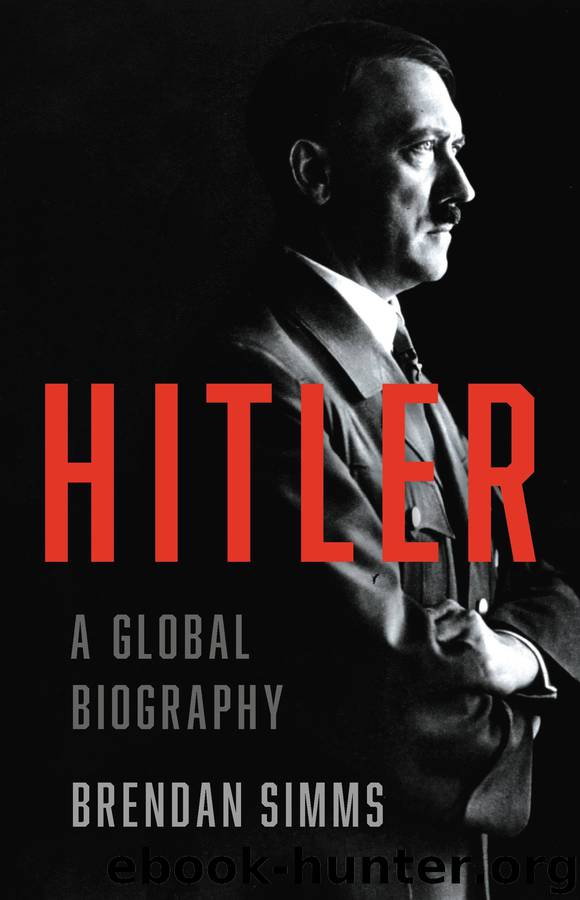
Hitler by Brendan Simms
Author:Brendan Simms
Language: eng
Format: epub
Publisher: Basic Books
Published: 2019-09-30T16:00:00+00:00
15
The ‘Haves’ and the ‘Have-Nots’
On 1 September 1939, the Wehrmacht invaded Poland. That same day, Hitler spoke in the Reichstag in a carefully choreographed appearance. He was addressing two audiences. One was the German people. To them, the Führer sought to justify the decision for war, and to shore up morale. For this reason, Hitler promised ‘no privations for Germans which I will not immediately share’. He underlined his new role as ‘the first soldier of the German Reich’1 by donning a simple grey jacket. The other addressee was the western powers, whose intervention he was anxious to avert. To them, Hitler signalled that he had ‘no claims in the west’ and that ‘our Westwall’ was ‘the border of the Reich for all times’. He also stressed that there would be no ‘capitulation’. ‘I would like to reassure the world at large,’ he averred, that ‘there will never be another November 1918 in German history.’2 It was the first of several wartime speeches, which Hitler used carefully for messaging purposes over the next six years. ‘In wartime I must weigh every word as if it were gold,’ he said, ‘because the world is attentive and sensitive.’ Hitler now rationed his appearances. ‘It was dangerous,’ he remarked, ‘to make speeches without having a plausible reason for doing so.’3
The Polish campaign was a resounding success.4 Danzig was captured in a coup de main. German tanks quickly overran the border defences, and advanced rapidly into the heart of the country. The plan of attack had been drawn up by the military leadership, but with considerable input from Hitler.5 He had disguised the offensive preparations as defensive measures. Hitler himself planned the commando operation against the bridge at Dirschau down to the smallest detail. More importantly, he had also insisted the pincer movement from East Prussia would not merely be a limited push to secure the Corridor but a much larger ‘great pincer’ designed to trap as many Polish forces as possible.6 Hitler did not, however, interfere in the operational conduct of the campaign, though he insisted on being briefed twice daily by telephone. Instead, shortly after the start of hostilities, Hitler set off on the first of several much-heralded ‘frontline travels’ to underline his commitment to his men. These journeys were not entirely without risk, as they exposed the Führer to air attack and even friendly fire, but they were essentially propaganda stunts.7 Hitler popped up at bridges and fords, or in field hospitals, with each photo opportunity calculated to give an impression of dynamism and ubiquity. The Poles proved no push-over, inflicting nearly 50,000 casualties, about a quarter of them dead, and they even launched a serious counter-attack on the Bzura against the forces advancing on Warsaw from the south-west.8 A fortnight into the campaign Hitler was sufficiently worried to urge the Soviet Union to hasten its intervention. On 17 September, Stalin invaded Poland from the east, taking a lot of pressure off the Wehrmacht. Nazi and Soviet forces met at Brest-Litovsk. Soon Polish resistance collapsed.
Download
This site does not store any files on its server. We only index and link to content provided by other sites. Please contact the content providers to delete copyright contents if any and email us, we'll remove relevant links or contents immediately.
Waking Up in Heaven: A True Story of Brokenness, Heaven, and Life Again by McVea Crystal & Tresniowski Alex(37948)
Still Foolin’ ’Em by Billy Crystal(36497)
Cecilia; Or, Memoirs of an Heiress — Volume 1 by Fanny Burney(32752)
Cecilia; Or, Memoirs of an Heiress — Volume 2 by Fanny Burney(32113)
Cecilia; Or, Memoirs of an Heiress — Volume 3 by Fanny Burney(32094)
Fanny Burney by Claire Harman(26752)
Empire of the Sikhs by Patwant Singh(23225)
We're Going to Need More Wine by Gabrielle Union(19240)
Hans Sturm: A Soldier's Odyssey on the Eastern Front by Gordon Williamson(18738)
Plagued by Fire by Paul Hendrickson(17560)
Out of India by Michael Foss(17044)
All the Missing Girls by Megan Miranda(16840)
Cat's cradle by Kurt Vonnegut(15589)
For the Love of Europe by Rick Steves(15001)
Pimp by Iceberg Slim(14823)
Molly's Game by Molly Bloom(14295)
Bombshells: Glamour Girls of a Lifetime by Sullivan Steve(14244)
Leonardo da Vinci by Walter Isaacson(13550)
4 3 2 1: A Novel by Paul Auster(12645)
